Bantering through The Remains of the Day

June 17, 2013

The Remains of the DayVery excitingly I will be hosting a book club at the Southbank Centre on Thursday night, where we will be discussing The Remains of the Day by Kazuo Ishiguro.

I was talking to a friend yesterday, who I shall call, somewhat cryptically, ‘S’, when the book came to my mind as being particularly apt. S was saying how extraordinary it is that men share a common bond of football. Her new husband, for instance, can talk to her father for ages about it. It’s true, I reflected, football is a remarkable common ground, which means that whenever men come across each other – in a shop, in a bar, in a taxi, at work – they have something light and bantering to say to each other.

We women don’t have an equivalent bantering common ground. At best, we can exchange a comment or two about clothes (I really love your jacket / thanks, your dress is very pretty / thanks, where’s your handbag from? …), which is somewhat limited and involves a weird sucky-uppy personal dynamic which is altogether absent from football banter. I wish that we women could find more common ground for the sisterhood! It’s a real absence. Perhaps books? We do, after all, read far more novels than men.

It seems, however, that this masculine aptitude for banter did not always come so easily. In The Remains of the Day, Mr Stevens – the butler and narrator – is forever lamenting his uselessness with banter. While he hadn’t needed to exchange bantering remarks in the glory days of Darlington Hall before the Second World War, now, in 1956, his new employer – Mr Farraday, who is, needless to say an American – indulges his bantering habit rather often. Stevens is thrown by this, doubly anxious because he can’t do it and because he thinks it might be one of his new professional duties:

It is quite possible, then, that my employer fully expects me to respond to his bantering in a like manner, and considers my failure to do so a form of negligence. This is, as I say, a matter which has given me much concern. But I must say this business of bantering is not a duty I feel I can ever discharge with enthusiasm. It is all very well, in these changing times, to adapt one’s work to take in duties not traditionally within one’s realm but bantering is of another dimension altogether. For one thing, how would one know for sure that at any given moment a response of the bantering sort is truly what is expected? One need hardly dwell on the catastrophic possibility of uttering a bantering remark only to discover it wholly inappropriate.

As you can see, poor Stevens is utterly at sea in this new post-War world of bantering.

Before the War, it was ‘dignity’ that Stevens strove for, emulating his father with his unwavering loyalty to his employer and conscientious hard work. There was no need to say much at all, aiming to be a near-invisible presence existing only to aid the smooth running of the house. Stevens’s desire to be as dignified as possible is put to great comic effect when Lord Darlington asks him to explain the facts of life to his twenty-three-year-old godson. Stevens tries to broach this rather undignified subject, ‘ladies and gentlemen differ in several key respects,’ and of course the godson fails to understand his euphemism, which is his attempt to dispatch the task with dignity. Oh if only they had some banter to fall back on!

Back to 1956, when a certain Mr Harry Smith tries to discuss politics with Stevens in a village, where Stevens is marooned for the night after his car breaks down. Smith gives a markedly different definition of ‘dignity’:

…it’s one of the privileges of being born English that no matter who you are, no matter if you’re rich or poor, you’re born free and you’re born so that you can express your opinion freely, and vote in your Member of Parliament or vote him out. That’s what dignity’s really about…

Stevens disagrees with this opinion, seeing dignity as tied to knowing one’s place, respecting one’s betters and being utterly loyal to one’s employer. That Lord Darlington ended up acting in such a thoroughly undignified way (I don’t want to spoil the plot for you so I won’t go into details) gives a sad irony to Stevens’s unflinching loyalty towards him.

‘Dignity’ has changed but Stevens hasn’t. The world has changed, and yet Stevens clings to the past. He is an anachronism. Yet, even Stevens can see the remarkable power of this new phenomenon of ‘banter’, observing at the novel’s end that: ‘in bantering lies the key to human warmth’.

Today, Stevens’s idea of dignity is almost entirely lost, sacrificed, perhaps, to this great masculine art of banter.

Daphne with The Remains of the Day

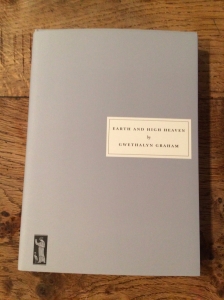
Here is my very beautiful Folio Society  edition of The Remains of the Day (now sadly out-of-print). Need I remind you that Daphne is a highly intelligent and very dignified tortoise, even if she offers little by way of banter.

Second-hand book-hunting with Cosybooks

June 12, 2013


*********************Introducing the first guest blog ***********************


This special spot is a chance for you to meet, or, indeed, reacquaint yourselves with, other talented book bloggers.

The first guest blogger is Cosy Books – a Canadian librarian, who has a penchant for brilliant twentieth-century novels written by women. A taste that I, for one, share. Here she takes you on an illuminating tour of second-hand book buying in Canada.

If you would like to contribute to the Emilybooks guest blog spot then get in touch here.

*********************************************************************************

If you have been following Emily’s blog for a while or landed here via a link from another blog you probably already know that a keen interest in books is a connecting thread.  While my fondness for reading reaches back as far as I can remember a certain group of book bloggers has made it possible for me to achieve an even greater appreciation for the written word.  This camaraderie has also unearthed a side of me which never existed before I carved out my own tiny space in the world of book blogging.  As a circulation clerk at a public library I nearly always borrowed my books but over the past few years I have turned into a book buyer on a mission.  It’s a nice way of saying that accumulating books at a rate faster than I can find space for them has become a pleasurable pastime.  Woeful posts by bloggers surrounded by bursting shelves only serve to reassure me that my guilt about unread books is unwarranted and that my collection is practically inadequate.

Since 2009, my reading has been centred around twentieth century authors such as Elizabeth Bowen, Elizabeth Taylor, E M Delafield, Dorothy Whipple and their contemporaries.  Since I have yet to meet another person in my daily life who has struck up a conversation about any of the aforementioned authors you can imagine how rare it can be to find their books in nearby shops.  This makes the hunt more challenging than if I were spending the day on Charing Cross Road, but not impossible.

Little Boy LostSo where have I found some of my favourite treasures, you might ask?  The best place for turn-over is called BMV Books.  They have a few locations in Toronto with my favourite being on Bloor Street.  Each day there are green plastic book bins dotting the floor waiting to be unpacked and shelved.  There is no catalogue so if you’re looking for something specific you have to be willing to dig for it.  The books are mostly used but in excellent condition. BMV also get batches of books sold back to them from local university students so you get an idea of what has been on offer in the English courses that term.  I was thrilled one day to spot the orange Penguin edition of Marghanita Laski’s Little Boy Lost, pushed back a bit further than the other books and for the pittance of only two dollars.  The Persephone edition was already on my shelves but that image of the little boy on the cover has always haunted me so I just had to bring it home.

The Tortoise and the HareAnother interesting place, albeit filthy, for some outstanding older clothbound books has been our local Reuse Centre.  Picture a massive warehouse full of the contents of your grandparents’ attic or garage sale rejects.  It’s an intriguing mix of dump run/nostalgia tour.  The lighting is horrible, my contact lenses go dry and you can taste the dust but it’s where I found a gorgeous black Virago edition of Elizabeth Jenkins’ The Tortoise and the Hare.  The cover design features a young lady wearing the most stunning pair of red tights and I’ve never seen another copy like it.  The funny thing is that it was discarded from the library where I work but it must have been ages ago.  A couple of years ago I brought home a first edition copy of New Bond Story by Norman Collins as well as a first edition of Flowers on the Grass by Monica Dickens for the same price.  Books such as these are housed separately from the paperbacks but the room resembles something more akin to a hallway at five metres long and barely wider than my shoulders and I’m not very big!  Bending is done very carefully and usually sideways!

The Way Things AreAnother place I loved to visit was called Nostalgia Books in Port Credit.  Nestled at the end of a long high street and a bit past the bridge over the harbour it was a nice destination when I had the day off from work.  The owner, David, was passionate about books (of course) but he also enjoyed people.  When he discovered my daughter had chosen to do a minor in English Literature he asked if I could keep him updated on her reading lists just for interest’s sake.  This shop was where I found my first green Virago, The Way Things Are by E M Delafield, and I beamed all the way home.  Last month my husband and I took a drive out to the shop but were saddened to find brown paper covering the windows and no sign of life.

For an anglophile living in the land of maple syrup and moose (I’ve only seen one that’s been stuffed but I’m going for effect) there can be no greater book hunting expedition than in England.  I could spend ages browsing along Charing Cross Road or the Southbank book market, admiring the faded spines and drinking in the aroma of aged chimney smoke you sometimes find emanating from the pages.  I can hardly believe it has been almost two years ago since I met up with my friends from Book Snob, Stuck in a Book and Mrs Miniver’s Daughter for a bit of second-hand book shopping while I was on holiday.  Mary was dreading a case of tug-of-war should we both spy a prize at the same time.  There was no need to worry though as they were more than helpful in handing over all sorts of titles they thought I would enjoy.  The charity shops in Canterbury where my daughter did her MA were oh so tempting but those dreaded luggage allowances are always at the back of my mind.

Look at all Those RosesRegardless of where my books have come from I never fail to get a tiny thrill from the signature of a previous owner along with a date.  My favourite inscription is in the front of a first American edition of Look at All Those Roses, a short story collection by Elizabeth Bowen published in 1941.  I have Rachel (Book Snob) to thank for this one.  It reads:

For Scott Merrill from John Butler in affection –

Elizabeth Bowen’s wisdom

May 1944

A story within a collection of stories but one which will have to remain a mystery.

The King of a Rainy Country

June 10, 2013

The King of a Rainy CountryAs some of you will have by now discovered, there are few things I love more than reading a book in its setting.

So it was a wonderful coincidence that when I began reading The King of a Rainy Country on Thursday morning, immersing myself in the bohemian world of Susan ‘somewhere off the Tottenham Court Road’, I remembered I was heading down to Soho that very evening for a friend’s birthday party. I decided that if I hurried down to Soho after my day at work in the bookshop, I might just have time to sit in a café for half an hour or so and read a little bit more before joining my friends.

After work, I hopped on the tube, hopped off at Tottenham Court Road and decided to treat myself to an unbelievably expensive coffee at Bar Italia, not least because I think the till they have there is so extraordinary and I wanted to have another peek at it. You could imagine my delight when I sat down with my coffee, feeling peculiarly on holiday with the background noise of Italian radio and the unusually warm evening, when I read in the novel that by extraordinary good fortune, Susan and Neale – her sort of but not quite boyfriend – stumble into a travel agents and end up getting jobs as ‘couriers’, i.e. tour guides, and going to Italy.

I felt as though, just for a moment, my world had collided with Susan’s. Although, as I emerged from the café and headed to the party, finding that everyone was now speaking English and the temperature had dropped rather, the illusion swiftly passed.

Susan is a sympathetic character in more ways than just this accident of circumstances. At one point, she asks another character why she likes her:

O, sympathy of some sort. Tu sei molto simpatico.

It is a huge achievement for a writer to create a character who one feels so instinctively aligned to, in sympathy with. Perhaps it is helped by the honest, confiding opening:

I had been scared for a fortnight. Concentrating on my fear, I became dogged and literal. At once another fear seized me; fear that I might bore Neal.

I recognized the day, the moment I woke, as the day of the interview. Only secondly did I remember I was moving house.

Who hasn’t woken up with that stomach-clenching realisation of terror – that feeling of argh today’s the day, the horrid sweaty nerves of a job interview? And how often has that day of terror collided with a completely different reason to be nervous – moving house or some such – when the fear doubles up on itself? It made me think of the awful morning I awoke to face my final A-level exam, followed by meeting my then boyfriend, who had been wanting to break up with me but had ‘thoughtfully’ decided to wait until I’d finished my exams. The double dread of having to go into that exam hall for an English paper and then walk down to St James’s Park to face the music with him was completely horrific.

You can’t help but sympathise with poor Susan, and admire the way she gets on with it in spite of her nerves, taking a taxi to Neale’s flat, then anxiously taking a bus to the interview:

My mouth was so dry that it caused me a palpable pain to ask for my ticket.

The moment I knew I was utterly committed to her was a couple of paragraphs later when she is walking down Park Lane to the interview and gets lost ‘in autobiographical fantasy’:

I told some imprecisely imagined interlocutor that each year I hoped to have outgrown being moved by the autumn and each year I hadn’t.

It’s just the sort of pretentious idle fantasy in which I indulge when wandering along. Mine usually goes along the lines of imagining what records I’d choose for Desert Island Discs, or what I’d say when asked about the inspiration for my first novel on The Culture Show. Far too long is spent in such vain, idiotic, autobiographical fantasy, and it is cringingly embarrassing to admit to. I loved Susan’s disarming honesty in telling us this straight up.

Of course when Susan then gets a job working for a bookseller, I essentially decided we were versions of the same person, and so shouldn’t really have been so surprised by the coincidence of my going to Italy via Tottenham Court Road that evening.

On the face of it, Brigid Brophy sets up a straightforward narrative. A young woman gets a job and moves in with her boyfriend. But Brophy is too playful and clever for this. The bookseller turns out not to be just a bookseller. just as his name turns out not really to be Finkelheim. The boyfriend turns out not really to be a boyfriend. It’s not long before they move settings and go to Italy to try out a whole new scenario.

Brigid Brophy wrote The King of a Rainy Country in 1956, a time when, I suppose, people’s narratives were beginning to seem particularly changeable. Brophy’s own life certainly twisted and turned, resisting a straightforward path. She went up to Oxford only to be sent down for ‘unspecified offences’. She married an art historian, but then had an open marriage, enjoying affairs with men and women. Like her creator, Susan doesn’t settle into a straightforward life.

It is the ambiguity of Susan and Neale’s relationship and their sexuality that is so exciting. One is always wondering, are they sleeping together? Are they about to sleep together? Are they falling in love? Is Neale going to sleep with the young French man he picked up, who knows no English other than the word ‘quair’? Is Susan still in love with Cynthia, her crush from school?

There is a casualness to gender and relationships that is refreshing today and must have been strikingly unusual in 1956. Susan and Neale are trying things out for size, experimenting with different roles, finding their feet with an innocence and naivete which is very endearing. It is no coincidence that the other works alluded to in the novel include As you Like it and The Marriage of Figaro – with their cross-dressing and ambiguous, playful treatment of gender.

I shall leave you the enjoyable, twisty-turny plot to discover for yourself. Be assured that it is peppered with very funny moments, as well as acute observations. There is an overarching poignancy for being that age, so free and open, and the vulnerability which that entails.

When they pass through Paris, Neale looks up at the shuttered windows:

“Anyway, what is it about the shutters?”

“The slats,” I said.

“Yes, it’s clever. They give an impression you can see in, though in fact you can’t. And isn’t that the whole of romance?”

Perhaps, then, this is the ultimately romantic book, teasing us with its subtle, playful opacity. You think you can see in to Neal and Susan’s relationship, but in fact you can’t. You think you can see into Susan’s feelings about Cynthia, but you can’t. It isn’t that Susan is wilfully hiding from the reader – as I said, she is winningly sympathetic – but she is still discovering her feelings and sexuality herself. We join Susan as she gradually prises open the shutters, and share the spirit of discovery, excitement and pain that it brings.

We should all be grateful to The Coelacanth Press for prising opening the shutters on Brigid Brophy herself. This remarkable woman who led an extraordinary life and, if this is anything to go by, wrote wonderful novels, is almost forgotten. The Coelacanth Press have republished The King of a Rainy Country as a labour of love – it being the only book they’ve published. I urge you to buy it and keep Brophy on the bookshelves. It might even encourage The Coelacanth Press to publish more work by such wrongly neglected, brilliant writers.

Brigid Brophy

River writing

June 3, 2013

To the River by Olivia LaingLast week, I was lucky enough to chair a talk about river writing. The speakers were Olivia Laing, who was talking about her beautiful book To the River (which I wrote about here), and Charles Rangeley-Wilson, who spoke about his fascinating search for a lost river, Silt Road. I really enjoyed listening to them discuss the many parallels in their experiences of these chalk streams – The Ouse and The (High Wycombe) Wye. Both wrote a great deal about fossils, love, death, and also stories.

These folk stories were some of my favourite moments of their books – amidst the lyrical nature writing and illuminating history – and seem to me to be perfect instances of landscape influencing imagination. Olivia told the story of Cherry of Zennor, which she came across in a collection of essays by Edward Thomas, who found it in the mid-nineteenth-century Popular Romances of the West of England. Charles wrote about a magical trout. I shall, briefly, fill you in on these tales:

Cherry of Zennor

Cherry, a sixteen-year-old girl, left her family in Cornwall to go into service. She was sitting on the Downs crying with homesickness, when a gentleman came towards her. He offered her a job working for him and looking after his son.

Cherry didn’t understand everything he said, for he spoke in a flowery way, but she decided to take the job.

They went together down a long sloping lane shaded with trees, so that the sun was barely visible. At length they came to a stream of clear dark water that ran across the road. Cherry didn’t know how she’d ford this brook, but the gentleman slipped an arm about her waist and scooped her up, so she wouldn’t wet her feet.

Every day, Cherry had to take his son to a spring in the garden, wash him, and anoint his eyes with ointment. She was told not to touch her own eyes with the ointment. Then she got on with the rest of the work – milking the cow and weeding the garden. Cherry felt suspicious of this ointment and so:

One morning… taking a crumb of ointment, she put it in her eye. How it burned! She ran to the stream to wash away the smarting and there she saw at the bottom of the water hundreds of little people dancing, and there was her master, as small as the others, dancing with them and kissing the ladies as they passed.

It’s not long before her faery master finds out she’s taken the ointment and sends her packing.

The magical trout

Silt RoadCharles Rangeley-Wilson recounts the story as told by a mysterious old lady to the early nineteenth-century Irish songwriter Samuel Lover. Here it is:

There was once a very long time ago, a beautiful young girl who lived in the castle by the lough. She was betrothed to a king’s son, but the story goes that the prince was murdered and thrown into the lough and that she went out of her mind, the poor, tender-hearted girl, and pined for him until at last, so it was thought, the fairies took her away. But then, this white trout appeared in the stream, though it had never been seen before, and there it has remained for years and years, longer than I can express, and beyond the memory of even the oldest hereabouts, until at last the people came to believe that the white trout was a fairy, and so it was treasured and no harm was ever done to it. None, that is, until a band of wicked soldiers came to these parts and laughed and gibed [at] the people for thinking like this and one of the soldiers said he would catch the trout and eat it for his supper. Well he caught it and took it home and the trout cried out when he pitched it into the frying pan, though it would not cook no matter which way he turned the fish or how hot he made the fire, until in exasperation the soldier lunged at the trout with a fork and there came a murdering screech such as you’ve never heard before and the trout jumped out of the pan and on to the floor and out of the spot where it fell rose up the most beautiful lady you’ve ever seen, all dressed in white with a band of gold in her hair and a stream of blood running down her arm. “Look where you cut me you villain,” said the girl. “Why did you not leave me watching out for my true love? For he is coming for me by the river, and if he comes while I am away and I miss him I’ll hunt you down for evermore, so long as grass grows and water runs.” And no sooner had she spoken than the girl vanished and there on the kitchen floor was the white trout and the soldier picked up the bleeding fish and rushed with it to the river. He ran and ran for fear her lover would come while she was away, and descending into this cavern he threw her back into the river and there she has stayed evermore and to this day the trout is marked with red spots where the fork pierced its side.

white trout

I hadn’t known that fairies and rivers were so closely linked. I love the thought of little fairies dancing and kissing each other in the stream. Perhaps that’s why the water feels so cool and tickly when you paddle in it.

Lore of the LandIntrigued by these stories, I went to my very reliable tome of English folklore, The Lore of the Land, to see if there were more tales about rivers and fairies. Endearingly there is no entry for ‘rivers’ in the index of The Lore of the Land, only:

river-spirits … see also mermaids, freshwater

The stories of river-spirits are sinister. The spirit of the River Dart called out ‘Jan Coo! Jan Coo!’ until Jan ran towards it, his friend powerless to stop him, and then Jan was never seen again. There is Peg Powler of the Tees:

one of the most formidable of the many river-spirits lurking in rivers and streams, waiting their chance to drown women and children.

Just as sad is the story of how the River Severn came to be named. The story is traced to the account given by Geoffrey of Monmouth (c.1136) – an old story indeed. An ancient legendery king, Locrine, fell in love with the beautiful Estrildis but was forced by his father to marry Gwendolen. Locrine still loved Estrildis so hid her in an underground chamber where he visited her in secret. This went on for seven years, during which time she bore him a daughter Sabrina. Eventually, Locrine deserted Gwendolen and raised Estrildis to be his queen. Gwendolen, understandably furious, gathered an army in Cornwall and in the ensuing battle Locrine was killed. Gwendolen resumed the throne and ordered that:

Estrildis and Sabrina her daugher be flung into the river that is now called Severn, issuing an edict throughout all Britain that the river should be called by the damsel’s name … whereby it cometh to pass that even to this day the river in the British tongue is called Sabren, which by corruption in other speech is called Severn.

Sad stories of rivers abound. I dutifully looked up freshwater mermaids, but found that they aren’t any more gentle than these river-spirits, and lurk in rivers, pits and pools to lure children beneath to their death.

I’m struck by the darkness felt in these stories, an unnatural sinister edge to the natural beauty of a river. Rivers give life but also bring death. Perhaps only something other-worldy can begin to explain the strange pull of a river, its magnetism that is strong enough to pull you out of this world altogether. Perhaps it was comforting to blame the many drownings on the fairies rather than natural force, or human error. Was Virginia Woolf lured by a mermaid or a river-spirit into the Ouse? I doubt that Leonard would have found comfort in this.

To me, these stories of ill-meaning river-spirits suggest the anarchy of a river, its stubborn wilfulness and refusal to be governed by man. Charles Rangeley-Wilson, whose book hopes for the re-emergence of the River Wye – now buried under a shopping mall – should take courage from these tales.

Midsummer’s Eve is just around the corner – a time when, legend has it, the gap narrows between human and fairy worlds. Beware the river-spirits and freshwater mermaids! It is also the time that Olivia Laing walked along the River Ouse for her book. Did she, like Shakespeare’s Hermia and Cherry of Zennor “see things with parted eye”?  At least she escaped the clutches of the fairies and mermaids and returned to tell her tales. I’d be quite happy for fairies to dance around my paddling feet, although I have to confess, I feel a little wary of getting too close to a river right now, just in case a mermaid were to pull me under. It is, for sure, at least a fine time to read about them.

Mermaid

Last Friends

May 28, 2013

Last FriendsFor all the wit that flashes brilliantly through its pages, Last Friends left me with a feeling of sadness. Sadness is a vague term, and I suppose it was a vague feeling. A malaise. Nostalgia. A sense of things that have gone, lives that have passed, ended, and how little survives them.

Last Friends is the final book in Jane Gardam’s magnificent trilogy about Raj orphan-lawyer Eddie Feathers, affectionately known as Filth – Failed In London Try Hong Kong. Gardam began with Old Filth, continued with The Man in the Wooden Hat (in which she looked at the story from the point of view of Filth’s wife Betty) and now she concludes with the story of Terry Veneering, Filth’s great rival in law and in love.

Gardam has a brilliant method of capturing the lives of her characters, building them up through flashes of memory, instances in the past that haunt them in the present. In Old Filth, Betty’s death prompts Filth ‘to flick open shutters on the past’, and so we learn about his life, from his childhood in Malaya, to his foster parents in Wales, to prep school and his early years at the Bar.

In Last Friends, both Filth and Veneering are dead. Who remains to flick open the shutters on their past?

Nobody really knows a thing about another’s past. Why should we? Different worlds we all inhabit from the womb.

So reflects Dulcie – one of the last surviving friends of Filth, Betty and Veneering. Her thoughts accompany us through a great deal of the book. The other ‘last friend’ is Fiscal-Smith, who begins as a tedious hanger on, but ends up coming across as quite endearing.

Do we all inhabit ‘different worlds … from the womb’? This question seems to me to be at the core of Gardam’s Filth novels. In each book, she looks at the same characters but takes a different angle. With this new slant, all sorts of alignments and symmetries, previously unseen, are revealed. It is the same world, and yet that sameness is made to feel alien; it is a different world, and yet it is revealed to be essentially the same.

In Last Friends, Gardam turns her authorial eye to Terry Veneering – Filth’s ever-present rival. She does this with tremendous skill, for throughout the other books Veneering has been cast with little sympathy. He is the antithesis to Filth, so we can’t help but dislike him. He is brash, drunk, loud, uncivilised. Added to which, he had an affair with Betty. What a genius Gardam is to turn this on its head and make us now understand Veneering, sympathise with him, even a little at the expense of our sympathy for beloved old Filth.

Veneering’s childhood seems indeed to be in a completely different world from Filth’s. He was born in the Northern village of Herringfleet to a coal woman and a Russian spy, disguised as an acrobat. And yet, these worlds aren’t so different after all. Veneering has a surprising meeting with ‘Sir’, Filth’s influential prep-school teacher. Indeed it is Sir who gives him his Dickensian name. There is also Veneering’s first glimpse of Betty – then Elizabeth Macintosh. And, just the day before this glimpse of Betty, he has his first case against Filth. Different worlds, but the same world; these lives were destined to cross with each other from the very beginning.

While Gardam looks back on Veneering’s beginning, this is really a novel about endings – and what comes after the end. These lives are over, and yet the novel is testament to the way Filth and Veneering live on in the memories of other characters. So long as Dulcie and Fiscal-Smith are around, we feel that Filth and Veneering haven’t quite disappeared.

Although they are far from reliable memories. There is a poignant moment when Dulcie realises she can’t quite remember what her dead husband looks like:

Oh Willy! She tried not to think of Willy in case, once again, she found that hse had forgotten what he had looked lie. Ah – all well. Here he came up the stairs, his fastidious feet, balancing teacups. Deeply thinking. Oh, Willy! So many years! I haven’t really forgotten what you looked like. ‘Pastry Willy’ – but you grew quite weather-beaten after we came Home. It’s just, sometimes lately you’ve grown hazy. Doesn’t matter. Changes nothing.

Memories fade and then what are we left with? Dulcie and Fiscal-Smith are painfully old too and not long for this world. Who will survive them? What will survive of this generation of wonderful characters?

To this end, Gardam brings in a younger generation. Anna and Henry have moved into Veneering’s old house, and plan to turn it into a B&B. They rifle through the attic, finding his old things, wondering at the stories which lie behind them. They also look after Dulcie very well.

Then there are moments like this, when Dulcie decides to get some eggs from the local farm:

There was a wooden box hung on a field gate. It had been there fifty years. You took out the eggs and left the money. Beautiful brown eggs covered in hen shit to show how fresh they were. Today she opened the flap of the box and there were no eggs and no money but a dirty-looking note saying, Ever been had?

She was all at once desolate. The whole world was corrupt. She was friendless and alone. Like Fiscal-Smith she had outstayed her welcome in the place she felt was home.

It is terribly sad. Living has changed from being a triumph of survival to a case of outstaying your welcome. Dulcie is so old that perhaps she’d be better off dead like Filth, Betty and Veneering. The world today is too ‘corrupt’ for these marvellous old creatures, who’ve lived such long extraordinary lives. These ‘last friends’ are the very end of that generation, and we are left thinking that once they perish, there will be nothing left of them.

Yet we can comfort ourselves with the knowledge that we have Jane Gardam, who preserves these lives with warmth, humour and respect. I long to re-read the other books now, and am quietly hoping that she might be persuaded to turn the trilogy into a quartet.

Jane Gardam

Just a little coda to say that I will – I hope – be survived by little Daphne, who has spent her first week chez EmilyBooks being particularly sweet. For those of you who are itching to see more of her, here she is attempting to eat my wellies. What can I say, we both share a love of all things yellow!

Daphne eating my wellies

Top Five Literary Tortoises

May 20, 2013

Big news this week in the world of Emilybooks.

Daphne

Meet Daphne!

This beloved belated birthday present from the husband joined us on Saturday morning, when we went and bought her from a very friendly pet shop in Essex. You’ll be pleased to hear that she is settling in well – enjoying bathing in the warm rays of her special heat lamp before pootling off to explore our flat.

Daphne on the rug

It is very peculiar trying to get on with my work while Daphne is here, scrabbling around. It is lovely to have a bit of company, a wise reptilian companion. I feel sure that we are already establishing a rapport – funny things like we both yawned at the same time this morning. And she wouldn’t touch her breakfast until I started munching my bowl of cereal. Perhaps I’m reading too much into this.

As I am so tortoise-brained this morning, and to welcome this marvellous little creature into the world of EmilyBooks, here are my Top Five literary tortoises.

Esio Trot

Esio TrotAlfie from Esio Trot must come first.

This is a delightful tortoise love story, written by Roald Dahl, and illustrated by Quentin Blake. Shy Mr Hoppy pines for Mrs Silver, who lives in the flat below. They strike up a friendship over her tortoise Alfie, who she worries won’t grow. Mr Hoppy comes up with a very clever plan. He writes down the following words on a piece of paper:

ESIO TROT, ESIO TROT,

TEG REGGIB REGGIB!

EMOC NO, ESIO TROT,

WORG PU, FFUP PU, TOOHS PU!

GNIRPS PU, WOLB PU, LLEWS PU!

EGROG! ELZZUG! FFUTS! PLUG!

TUP NO TAF, ESIO TROT, TUP NO TAF!

TEG NO, TEG NO, ELBBOG DOOF!

He tells Mrs Silver to whisper this spell to her tortoise three times a day and, he assures her, Alfie will get bigger. They are of course normal words written backwards!

Mr Hoppy bulk buys tortoises in all different sizes and when Mrs Silver is out, reaches down to her balcony and swaps Alfie for a very slightly bigger tortoise. And so on… Mrs Silver is at first thrilled that Alfie seems to be getting bigger, but of course women have a habit of changing their minds and are never happy with something for long…

Having bonded over Alfie, Mr Hoppy plucks up the courage to ask Mrs Silver to marry him and everyone – including the original Alfie – lives happily ever after. Who knew tortoises could be such a fruitful conversation opener?!

Esio Trot

The Tortoise and the Hare

Yes, there is Aesop’s fable, which we all know so well, with its moral that slow and steady wins the race. I have to say, little Daphne is surprisingly speedy. Look at her go!

Daphne and duct tape

The Tortoise and The HareI am thinking, however, of the novel by Elizabeth Jenkins, which I wrote about at length here. This wonderful, too-often overlooked novel from the 1950s is another tortoise love story, although rather more complicated, adult and with only a metaphorical tortoise.

Lovely, gentle self-effacing Imogen is married to brute of a bullying barrister husband Evelyn. Their neighbour – stout, brash Blanche Silcox – makes a play for Evelyn … which of these utterly contrasting women will win?

What is so clever about Jenkins’s book is that as you read it, you’re forever questioning who is the tortoise and who the hare. I suppose it depends a little on where you think the finish line is. Is Evelyn really the prize, or is it independence and freedom from such a brutish man?

Brideshead Revisited

Brideshead RevisitedThe poor tortoise in Brideshead Revisited has been horribly abused. Julia come into the drawing room telling Lady Marchmain to look at the Christmas present that Rex has given her:

It was a small tortoise with Julia’s initials set in diamonds in the living shell, and this slightly obscene object, now slipping impotently on the polished boards, now striding across the card-table, now lumbering over a rub, now withdrawn at a touch, now stretching its neck and swaying its withered, antediluvian head, became a memorable part of the evening, one of those needle-hooks of experience which catch the attention when larger matters are at stake.

Just a few pages later, the poor tortoise, jewels and all, is said to have buried itself. We learn this soon after Charles Ryder leaves Brideshead, telling himself he shall never go back, and that:

I was leaving part of myself behind, and that wherever I went afterwards I should feel the lack of it, and search for it hopelessly, as ghosts are said to do, frequenting the spots where they buried material treasures without which they cannot pay their way to the nether world.

A diamond-encrusted tortoise would get you far indeed into the nether world. Not as far, however, as Catholicism, as Waugh is keen to point out.

Brideshead tortoise

Momo

momoThere is a wonderful tortoise called Cassiopeia in Momo by Michael Ende. I read this book when I was about ten and for years felt terrified of the sinister Men in Grey, who:

had an uncanny knack of making themselves so inconspicuous that you either overlooked them or forgot ever seeing them… Since nobody noticed them, nobody stopped to wonder where they had come from, or indeed, were still coming from, for their numbers continue to grow with every passing day.

I used to associate them with men in suits. Perhaps that’s the point. It is a wonderfully anti-establishment children’s book.

Momo is a little orphan girl, with a knack for listening to people. When the Men in Grey turn up, they persuade everyone that they have to ‘save time’, which results in them stopping doing everything fun and always being in a rush. It’s an awful trick, of course. Everyone becomes miserable thanks to their time-saving, but the Men in Grey need everyone else’s time to survive, smoking their sinister cigars of hour lilies. Yes, it is a surreal book.

Momo fights against the grey men with the aid of Professor Hora and his tortoise, Cassiopeia, who can see half an hour into the future and – better yet – can communicate, helping Momo by making words appear on her shell.

 Michael Ende with tortoise

Apparently Michael Ende had a soft spot for tortoises. I don’t blame him!

Baby tortoise

Tortoises by DH LawrenceI shall end with D.H. Lawrence’s beautiful poem about a baby tortoise:

You know what it is to be born alone,

Baby tortoise!

The first day to heave your feet little by little from the shell,

Not yet awake,

And remain lapsed on earth,

Not quite alive.

A tiny, fragile, half-animate bean.

To open your tiny beak-mouth, that looks as if it would never open

Like some iron door;

To lift the upper hawk-beak from the lower base

And reach your skinny neck

And take your first bite at some dim bit of herbage,

Alone, small insect,

Tiny bright-eye,

Slow one.

To take your first solitary bite

And move on your slow, solitary hunt.

Your bright, dark little eye,

Your eye of a dark disturbed night,

Under its slow lid, tiny baby tortoise,

So indomitable.

No one ever heard you complain.

You draw your head forward, slowly, from your little wimple

And set forward, slow-dragging, on your four-pinned toes,

Rowing slowly forward.

Wither away, small bird?

Rather like a baby working its limbs,

Except that you make slow, ageless progress

And a baby makes none.

The touch of sun excites you,

And the long ages, and the lingering chill

Make you pause to yawn,

Opening your impervious mouth,

Suddenly beak-shaped, and very wide, like some suddenly gaping pincers;

Soft red tongue, and hard thin gums,

Then close the wedge of your little mountain front,

Your face, baby tortoise.

Do you wonder at the world, as slowly you turn your head in its wimple

And look with laconic, black eyes?

Or is sleep coming over you again,

The non-life?

You are so hard to wake.

Are you able to wonder?

Or is it just your indomitable will and pride of the first life

Looking round

And slowly pitching itself against the inertia

Which had seemed invincible?

The vast inanimate,

And the fine brilliance of your so tiny eye,

Challenger.

Nay, tiny shell-bird.

What a huge vast inanimate it is, that you must row against,

What an incalculable inertia.

Challenger,

Little Ulysses, fore-runner,

No bigger than my thumb-nail,

Buon viaggio.

All animate creation on your shoulder,

Set forth, little Titan, under your battle-shield.

The ponderous, preponderate,

Inanimate universe;

And you are slowly moving, pioneer, you alone.

How vivid your travelling seems now, in the troubled sunshine,

Stoic, Ulyssean atom;

Suddenly hasty, reckless, on high toes.

Voiceless little bird,

Resting your head half out of your wimple

In the slow dignity of your eternal pause.

Alone, with no sense of being alone,

And hence six times more solitary;

Fulfilled of the slow passion of pitching through immemorial ages

Your little round house in the midst of chaos.

Over the garden earth,

Small bird,

Over the edge of all things.

Traveller,

With your tail tucked a little on one side

Like a gentleman in a long-skirted coat.

All life carried on your shoulder,

Invincible fore-runner.

Isn’t it brilliant?!

Let us hope that little Daphne will inspire me to similar great heights of tortoise literature.

Daphne coming out

And yes, that book on to which she is climbing is none other than The Tortoise and the Hare by Elizabeth Jenkins.

The Dark is Rising

May 14, 2013

The Dark is RisingI began re-reading Susan Cooper’s The Dark is Rising quintet at Christmas. I was staying at my Mum’s and one night I found I was unable to sleep, having snoozed through most of the afternoon. Looking through the bookshelves of my childhood, filled with Beatrix Potter, Swallows and Amazons, the multi-coloured Children’s Britannica, and other nostalgic delights, I alighted on this slim collection of novels with way-out fantasy covers. I remember being so terrified by the cover of The Dark is Rising (the second in the series) that I couldn’t sleep with it turned upwards by my bed, and always had to leave it face down, preferably safely hidden underneath another book.

Over Sea Under StoneThat night I re-read, cover-to-cover, Over Sea, Under Stone, which is the first in the series. It is about the three Drew children who go on holiday to Cornwall. They stay in an old house, where they discover an old map and they soon find themselves on a quest for King Arthur’s grail. Funny how in children’s literature, when you go on holiday you tend to find yourself on a very exciting quest, whereas in adult literature, you go on holiday and either fall in love or discover something about yourself. Even now I’m a grown-up, I’d rather my holidays followed the first plot line.

This family adventure story that’s set in a Cornwall steeped in Arthurian legend is great fun, but it doesn’t begin to prepare you for the books that are to come.

The Dark is Rising, which I read a couple of weeks later when feeling poorly, is a terrifying coming-of-age story. It begins on Midwinter’s Eve, the night before Will Stanton’s eleventh birthday:

It was then, without warning, that the fear came.

The first wave caught him as he was crossing the room to his bed. It halted him stock-still in the middle of the room, the howl of the wind outside filling his ears. The snow lashed against the window. Will was suddenly deadly cold, yet tingling all over. He was so frightened that he could not move a finger … there was only a dreadful darkness in his mind, a sense of looking into a great black pit.

It’s a brilliant description of terror, which we soon learn is an expression of the Dark. Will Stanton discovers that he is the last of The Old Ones, a force for the Light. He is about to embark on his first quest for the Light, helped on his way by Merriman Lyon, who we met in the first book.

This gives a new resonance to children’s common fear of the dark. Throughout the books, the Dark’s presence is often felt psychologically – a dark fug of fear not a million miles from J.K. Rowling’s Dementors – rather than physically. The Grey KingThis idea is explored again in the character Caradog Prichard in the fourth book of the series, The Grey King. Caradog is clearly not a good person, but Will suddenly understands the awful full implication of this:

Will was filled with an overpowering compassion: an awareness of what must inevitably overtake Caradog Prichard if he were not checked, now, for always, in this passion before it was too late. Stop he longed to call to him: stop, before the Grey King sees you and puts out his hand in friendship, and you, unwitting, take it and are destroyed…

Man’s ambition and weakness can be taken advantage of by the Dark for its own terrible ends.

In The Dark is Rising, Cooper is very good at depicting the challenges and contradictions of Will’s double life. One minute he’s the youngest child in a big family, sparring with his older brothers, saving up pocket money for Christmas presents, feeding the rabbits. The next he’s on a terrifying magical quest, trying to save the world from the forces of the Dark.

Of course Will’s situation is greatly exaggerated, but I remember a similar feeling from childhood of having a whole complicated imaginary world which was completely separate from adult reality. Whether it was from reading books, or playing games, or organising midnight feasts, there was always something going on which felt top secret, that the grown-ups wouldn’t understand and that had to be concealed from them at boring moments like supper or home-time. Cooper brilliantly captures this feeling of a child’s life being an intersection of different worlds.

GreenwitchThe Drew children re-appear, alongside Will Stanton, in the third book, Greenwitch, which is a kind of feminine Wicker Man. Then there’s The Grey King – every bit as terrifying as The Dark is Rising, when Will stays with some cousins in Wales, where he meets the mysterious albino boy Bran. Finally, there’s Silver on the Tree, which brings all the characters together in the ultimate test of good versus evil.

There is much to enjoy in this quest-filled quintet, but above all, I love the way the series is so firmly rooted in the British landscape, inspired by British stories and traditions. The Grey King, for instance, centres on Welsh tropes. At the heart of the story is the Brenin Llwyd, traditionally a Celtic King who lives in the Snowdonian mountain Cader Idris. Cooper casts him as a force for the Dark. Will has to find a golden harp – a Welsh object if ever there was one – and there is even an important sheepdog.

Silver on the TreeIn Silver on the Tree, the tree of the title is in the Chilterns. This is the scene when they find it:

Then the last of the mist blew away, and in the dim light beneath the lowering sky they saw a line of trees before them, a wood of beech trees capping a round chalk hill – and, gradually appearing on the slope in front of the wood, a single huge tree … It was an oak tree, more vast and ancient than any tree they had ever seen.

I’m not sure there could be a more English landscape!

These books are about oak trees and other trees and the folklore of English wildflowers and Welsh mountains. They are about Celtic myth and Arthurian legend, and about the Old Ways – ancient paths through the landscape that have magical powers of protection (Robert Macfarlane should take note).

Cooper often transports her characters from the present day to an ancient time, while keeping the place the same. It is a wonderful way of capturing the layers of history encapsulated in the landscape, or as Macfarlane would put it, the land’s ‘storiations’.

Susan Cooper wrote Over Sea, Under Stone when she was working at The Sunday Times in London. The rest of the quintet came later, however, once she’d moved to America. Cooper was very homesick and in an interview on her website she says:

I was so homesick that when I went home to Wales to visit my parents a few months after moving, my husband later said he was afraid I wouldn’t come back … My homesickness never went away. It bubbled up into The Dark Is Rising, a fantasy about the Light and the Dark that is at the same time intensely English, every inch of it set in the part of Buckinghamshire where I grew up.

Perhaps this vivid conjuring of British landscape in the books helped to ease her homesickness. It certainly transports the reader to the various settings, making me long to go to Cornwall, Wales and Buckinghamshire.

I loved re-reading these books from my childhood and found they had definitely stood the test of time. I find children’s books are best read when feeling a little overtired or poorly – there is something about the imaginative quests and the elemental background of good versus evil which really takes hold of my mind when it’s already feeling somewhat unhinged from reality. I think next time I read The Dark is Rising sequence will be when I go on a staycation to Wales, Cornwall or Buckinghamshire. They would definitely bring a new resonance to the landscape and who knows, perhaps the holiday would take a more adventurous turn.

And for those of you who are either terrified by the old Michael Heslop covers or unimpressed by the current Penguin ones, you might be tempted by these completely beautiful editions with illustrations by Laura Carlin, recently published by The Folio Society.

Folio Society editions of The Dark is Rising

Textermination

May 8, 2013

BookshelvesA couple of months ago I wrote a piece for the Spectator Books blog about how one ought – or, indeed, ought not – to arrange one’s bookshelves. I revealed the scintillating news that many of my books are arranged as though they are at a huge literary party: I think of which characters might get on with characters in other books and put them next to each other. So, for instance, Old Filth by Jane Gardam is next to Offshore by Penelope Fitzgerald because I think that Eddie Feathers (a.k.a. Filth) would get on well with Richard from Offshore. On Offshore’s other side is Vita Sackville-West’s All Passion Spent – while Lady Slane might not entirely approve of Offshore’s Nenna, I feel sure that she’d sympathise with her, as they both defy their family in choosing where to live, be that in a small house in Hampstead or on a rickety boat on Battersea Reach. Knowing what a bore it can be to get stuck with someone and unable to shake them off for hours at a party, I shuffle the books around now and again. I’m sure that Mrs Dalloway would approve.

TexterminationGiven this somewhat eccentric means of arrangement, which would, no doubt, be the bane of any librarian’s well-ordered system, I was delighted to read Textermination by Christine Brooke-Rose, a novel about just this sort of literary party.

Thousands of characters from literature converge upon the San Francisco Hilton to pray for their continued survival in the minds of readers. Everyone is here – from Odysseus to David Copperfield, Emma Woodhouse to Emma Bovary, Mrs Dalloway to Gibreel Farishta (who causes no end of trouble). How thrilling to see them all meet one another, form friendships and enjoy each other’s company. On a group excursion, for instance, here are some of the encounters that take place:

What a strange country America is, says Becky Sharp to her neighbour Friday, who grins and says island, very big.

Lazarillo, Oliver Twist, Gavroche, Mowgli, Janek Kowalksi and Huck Finn are scrambling up and down the rocks, having hilarious and noisy fun.

Lotte looks as ever for Goethe but finds herself instead with a Dublin Jew called Leopold Bloom, who talks a great deal but of things quite beyond her ken, except when he describes the preparation and eating of fried kidneys. Ugh!

It’s too brilliant!

Many might be put off by the huge knowledge of literature that Brooke-Rose assumes of her reader. I doubt whether even the most erudite of literary professors would recognise absolutely every character mentioned in Textermination. Worry not, for Brooke-Rose gives us a character – Kelly, a helper at the convention – who shares our neurosis:

She barely has time to glance at the cards, and to her horror she doesn’t recognise every name … Who was Charlotte Kestner, for instance, out of Thomas Mann? Who was the handsome young Indian labelled Aziz? Or a splendid Arab king of Granada labelled Aben-Hamet, or even Philip II out of she didn’t see who? Those at least she should have known. She feels ashamed and rattled. Gaps, so many gaps in her reading, she’ll never catch up.

‘So many gaps….’ This worry of never managing to catch up is the reader’s perennial complaint. It is only made worse by the fact that the more you read, the more you discover there is still to read. The huge crowds at this convention at the San Francisco Hilton suggest the impossibility of being able to read everything – it’s too overwhelming, you will never catch up.

Brooke-Rose matches our complaint with the complaint of the characters: we worry about not reading enough, and they angst over not being read enough. We might worry about not being able to remember quite what happens in a book, or which books to give to the charity shop when we run out of space on our shelves, but they worry about how long they’ll manage to stay on those shelves – how long before they get thrown out, or a publisher sentences them to going out-of-print. Now I’ve read Textermination, I’m not sure I’ll ever be able to get rid of a novel again. (Although I’ve never been particularly good at that.)

It stands to reason that as the characters are all in books and attending a literary convention, they might want to discuss this common ground, not just the ‘preparation and eating of fried kidneys’. We see some of them in a café discussing ‘I-narrators’. Henry James’s Strether accuses the narrator of The Aspern Papers  of being ‘an unmitigated scoundrel’ and then, on being accused of being a third-person narrator, gives a nice one-liner about James Wood’s free indirect speech:

I believe it comes to the same thing you know, says Strether, it is my viewpoint throughout.

At the end of this meeting, rather ominously, ‘Humbert, Humbert, who hasn’t said a word, takes Maisie by the hand.’

As you might suspect, the convention does not run smoothly, and there are various challenges to it which the fictional characters struggle to overcome. One takes the form of an invasion by screen characters, leading to a massive fight between characters from written narrative fiction and those from film and television. Dante’s Virgil tells Jude (the Obscure) and Dorothea that it’s ‘nothing compared to the Inferno’. Still, the convention must resort to tear gas in order to end the commotion. Then they begin to debate. JR from Dallas says:

Serials come off the air and sometimes return. But more often they do not. Dallas, for instance, which ran for two decades or more, has been axed. And then we’re deader in the short public memory than anyone in a book.

It is a comical and dramatic way of staging a good question: which characters are more real – those on television or those in a book? It is just one of many pert questions about literature and the value of it that Brooke-Rose asks, masked in her riotously imaginative set-up. You can perhaps imagine the confusion when film adaptations of characters meet their literary originals.

Textermination reminded me of the reader’s responsibility to read widely and to read well. Brooke-Rose conjures a great deal of pathos for her characters, all neurotically shuffling around the Hilton praying for their survival. Only we – the readers – can grant this to them. We think, therefore they are. ‘So many gaps’, thinks the reader, but this book should encourage us to keep on trying to fill those gaps, to continue to explore all these brilliant books, to not be cowed but inspired by the wealth of literature that lies ahead of us. Textermination serves both as a welcome reminder of some of our favourites and a tantalising introduction to the literary treasures that we’ve yet to read.

In adopting all these characters from other novels, Brooke-Rose deliberately draws attention to herself as a reader as well as a writer. We should be inspired by her example and use our own readerly powers to keep the characters alive. As well as overcoming all the obstacles and challenges which the convention comes up against – from terrorist attack to blazing inferno – the characters have all survived their authors. Sadly, Christine Brooke-Rose passed away last year, making her the second author (at least) that most of these characters have outlived. Perhaps they are kind enough to pass a little of their immortality on to their writers. Certainly the characters in Textermination conjure a woman of brilliant intelligence, with a wonderfully mischievous imagination, who was also a voracious reader. Inspiration for us all.

Christine Brooke-Rose

Coin Locker Babies

April 29, 2013

Coin Locker BabiesThe moments I found most compelling in this energetic, violent and hallucinatory Japanese novel are the descriptions of decaying landscapes. Here is one that comes near the beginning, when the two main characters – Kiku and Hashi – discover an abandoned mining town:

They cut across the playground of the abandoned school, past a twisted and broken horizontal bar. Cactuses grew luxuriantly in the sandbox, their needles covering the surface of a nearby pool filled with murky water. Three telephone poles, rotted and splitting, provided a nest for thousands of termites, and clouds of transparent wings filled the air. Beyond this translucent curtain, the boys could make out a town, or rather a row of empty shops facing a row of abandoned brothels and bars, and between the two a street from which the pavement was mostly gone.

“Look! Isn’t that beautiful!” cried Hashi, suddenly pointing toward a pit which contained, apparently, all the broken glass tubing from the neon signs on the bars and restaurants. The shards formed a luminous carpet that sparkled when the wind blew, shifting the bits of glass to catch the sunlight at new angles.

Ryu Murakami twists these images of dilapidation so that decay becomes beautiful. Termites are seen as a ‘translucent curtain’; a pit of broken glass is a ‘luminous carpet’.

This transformative process goes on throughout the novel. Violence becomes elegant and repulsive images grab you. It is certainly not for the squeamish, but you can work that out just from the very first sentence:

The woman pushed on the baby’s stomach and sucked its penis into her mouth; it was thinner than the American menthols she smoked and a bit slimy, like raw fish.

Hashi and Kiku are two babies, who are found abandoned in coin-operated lockers. They are taken into an orphanage, where they become inseparable, and are then adopted as brothers. The novel follows their lives as they grow up and spin out in different directions.

Neither of them is able to shed his awful start in life, those early hours of being left in a coin locker. When they are at the orphanage, they start to show characteristics of autism and are taken to a therapist who plays them the sound of a heartbeat. They spend their lives haunted by this sound, and by other repressed memories from their early years.

Kiku and Hashi never manage to leave their coin lockers behind. As they grow up, they move into other suffocating institutions and bounded societies – orphanages, schools, a prison, a recording studio, the hold of a boat, a mental institution. The book abounds with these closed confining spaces, making stark opposites to the open, uncared for wild places beyond these walls. There is the abandoned town, described above, and ‘Toxitown’ – an imagined part of Tokyo where society’s castoffs live lawless lives of violence, prostitution and yet also freedom.

The original coin lockers come to stand for these other institutions and for society as a whole:

Nothing had changed, not one thing – not since he’d let out that first scream in the coin locker. The locker was bigger, maybe; the new one had a pool and gardens, with a band, people wandering about half-naked, and you could keep pets – yes this one had all kinds of shit; museums, movie theaters, and mental hospitals – but it was still a huge coin locker, and no matter how many layers of camouflage you had to dig through if you felt like digging, in the end you still ran up against a wall.

The two boys are always pushing against the walls that confine them. What Murakami does so brilliantly is conjure what is on the other side of those walls. Toxitown is a bleak vision of violence, a kind of anti-society. It is a dystopia in which the two boys seem to flourish. Murakami’s portrayal of this lawless world begs all sorts of questions: Would we become these sawed-off-shotgun-wielding crazies and glassy-eyed prostitutes if we didn’t play by the rules of society? Is this anti-society better than our current society? These difficult questions make for disturbing yet compelling reading.

Coin Locker Babies is one of four novels by Ryu Murakami published by Pushkin Press this week. Best known for publishing intelligent European classics, like Stefan Zweig (see this post) and Antal Szerb, these books by Murakami suggest that Pushkin is branching out to the rest of the world. While, on the face of it, Coin Locker Babies couldn’t be more different to something like Zweig’s Beware of Pity, both books are gripping and unexpected. They both suck you into a different, stranger world. I’m excited to see what Pushkin will publish next.

Ryu Murakami

My Top Five Literary Springs

April 22, 2013

On Saturday, when the hour of my precious lunchbreak struck, I sprang out of the bookshop and into the sunshine, hurried to Hampstead Heath and lay in the grass, grinning as blotchy patterns flashed on the lids of my closed eyes.

Spring is here.

What better way to celebrate these first moments of sunshine, these first breaths of balmy, flower-scented air than with five favourite springtime books? (Click on the various links if you’d like to read longer posts about them.)

1. The Enchanted April by Elizabeth Von Arnim

The Enchanted April pbkI wrote about this last week, so here all I shall do is reiterate that it is a heavenly book. The plot is a bit daft, yes, but in a charming way. You read it and feel as though you are on holiday, that you are with those dotty ladies in San Salvatore, basking in the beautiful Italian spring. Let us briefly share Lotty Wilkins’s joy as she opens the shutters on her first morning:

All the radiance in Italy lay gathered together at her feet. The sun poured in on her. The sea lay asleep in it, hardly stirring. Across the bay the lovely mountains, exquisitely different in colour, were asleep too in the light; and underneath her window, at the bottom of the flower-starred grass slope from which the wall of the castle rose up, was a great cypress, cutting through the delicate blues and violets and rose-colours of the mountains and the sea like a great black sword.

2. The Beginning of Spring by Penelope Fitzgerald

The Beginning of Spring

It is 1913 and spring comes to Moscow, stirring revolutionaries into action and an English family into crisis. Penelope Fitzgerald is my favourite writer, as many of you know. This is a particularly good book, with her characteristically astute observations of a different place and time, laced with gentle humour, realised in beautiful prose. Towards the end, the children of the family go away with the mysterious new servant Lisa Ivanovna to their dacha in the woods, which is infused with the scent of the ‘potent leaf-sap of the birch trees’:

They had March fever. They were going out of the still sealed-up, glassed up house into the fresh, watery, early spring.

The house is ‘still sealed-up, glassed up’ against the fierce Russian winter, which is just coming to an end. The book closes with the definitive change of season and a wonderful passage describing the unsealing of the windows. Then:

Throughout the winter the house had been deaf, turned inwards, able to listen only to itself. Now the sounds of Moscow broke in, the bells and voices, the cabs and taxis which had gone by all winter unheard like ghosts of themselves, and with the noise came the spring wind, fresher than it felt in the street, blowing in uninterrupted from the northern regions where the frost still lay.

This weekend, we Londoners were not so different from that Moscow house. We’ve spent the winter ‘turned inwards’ – cold, muffled, shrouded in darkness – but now we are out in the bright streets, in the parks, listening to the noise of the city and feeling the fresh spring wind.

3. Illyrian Spring by Ann Bridge

Illyrian SpringLady Kilmichael is fed up with her philandering husband and difficult daughter and so decides to travel first to Venice and then on to the Dalmatian Coast, painting as she goes. Her path crosses with that of Nicholas, a young man determined to be a artist, in spite of his parents’ disapproval. They travel and paint together, until things become a little complicated…

This delightful novel has a similar feel to The Enchanted April, in that as you read it, you are transported to the warmer climes of the Mediterranean and the drowsy wellness that comes with a holiday. It also shines with descriptive travel writing. Ann Bridge was the wife of a diplomat and so was a seasoned traveller. This is one of my favourite views:

All over the ledges of these pearly rocks, as thick as they could stand, grew big pale-blue irises, a foot or more high, sumptuous as those in an English border, their leaves almost as silver as the rocks, their unopened buds standing up like violet spears among the delicate pallor of the fully opened flowers – Iris pallida dalmatica, familiar to every gardener, growing in unimaginable profusion in its native habitat. Now to see an English garden flower smothering a rocky mountainside is a sufficient wonder, especially if the rocks are of silver colour and the flowers a silvery blue; and Nature, feeling that she had done enough, might well have been content to leave it at that. But she had a last wonder, a final beauty to add. In the cracks and fissures another flower grew, blue also, spreading out over the steep slabs between the ledges in flat cushions as much as a yard across – a low-growing woody plant, smothered in small close flower-heads of a deep chalky blue, the shade beloved of the painter Nattier. Anything more lovely than these low compact masses of just the same tone of colour, but a deeper shade, flattened on the white rocks as a foil and companion to the flaunting splendour of the irises, cannot be conceived.

The description, with its precise renderings of different shades of colour, seems apt given that it’s seen through the eyes of an artist. I hadn’t realised that irises were native to Croatia. They are one of my very favourite flowers – especially the yellow variety which we saw in profusion in Scotland – and now, whenever I see them in a garden, I think of this vision of a mountainside covered in a silvery-blue sea of them.

4. The Constant Nymph by Margaret Kennedy

The Constant NymphThis strange and powerful novel, written by someone who Anita Brookner termed ‘not only a romantic but an anarchist’, begins with a wonderful depiction of the ‘Sanger circus’ holidaying in the Austrian Alps. They are not an actual circus, but a family of wild, musical children, headed by their father Sanger, a great musician, and added to by various other musicians, most notably young handsome Lewis Dodd. They spend their days cavorting around the mountainside and singing. When Sanger dies (we discover this at the beginning), cousin Florence, a sensible, cultured young English woman, comes out to the Tyrol in her ‘neat grey travelling hat and veil’ to take this troop of cousins in hand:

The children could not believe that they were really related to such a marvellous creature. They stared expansively.

Florence blossoms in the Alpine spring, charming the children and Lewis Dodd too. Yet when she takes them back to England, sending them to various boarding schools, and trying to settle down to married life with Lewis, she slips back into her English habits, but Sanger’s circus refuses to be tamed. As her imposed order begins to unravel, the lost carefree days of the Austrian spring seem more and more enchanted.

5. I Capture the Castle by Dodie Smith

I Capture the CastleOne of my very favourite, most comforting books, I Capture the Castle begins in spring, when the young American heirs to the estate first visit the dilapidated castle where the Mortmains, in all their bohemian squalor, roost. It is a novel packed with funny and delightful scenes, such as Cassandra’s interrupted bath-time; the brilliant episode when Rose, in her newly-inherited furs, is mistaken for a bear; and a magical night-swim in the moat. I suppose this makes it sound a little like a fairytale, but it’s too comical for that. Here is a bit from the moat swim. Cassandra has nobly taken one of the heirs swimming in order to let her sister Rose have a romantic tête-à-tête with the other heir:

We were in full moonlight. Neil had patches of brilliant green duckweed on his head and one shoulder; he looked wonderful.

I felt that what with the moonlight, the music, the scent of the stocks and having swum round a six-hundred-year-old moat, romance was getting a really splendid leg-up and it seemed an awful waste that we weren’t in love with each other – I wondered if I ought to have got Rose and Simon to swim the moat instead of us. But I finally decided that cold water is definitely anti-affection, because when Neil did eventually put his arm around me it wasn’t half so exciting as when he held my hand under the warm car-rug after the picnic.

The spring of I Capture the Castle is the perfect setting for our heroine, the narrator Cassandra. She is in the spring of her life, just beginning to blossom.

These are five wonderful books, and this is a particularly good time to read them, with the feel of the sun on your skin and the breeze in your hair. And, when the weather inevitably breaks, let’s hope we can find comfort in the spring delights held within their pages.

As always, I’d love to know your thoughts on these books, or any other suggestions for good spring reads.


Follow

Get every new post delivered to your Inbox.

Join 180 other followers